The Talent Tree is one of the most important account-wide progression systems in MK Mobile. Unlike Character Fusion or Equipment, Talents are not tied to one fighter. A good setup can improve every compatible team you use and can completely change how you approach Towers, Krypt, Survivor and other difficult battles.
There is no single Talent Tree that is best for every account.
A team built around Combo Enders and Death Mark wants different talents from a DOT team built around Fire, Poison and Bleed. A Survivor setup may sacrifice damage for Revenant and Bone Shield, while an Special Attack 2-focused attacker has little reason to prioritize talents designed around repeated Special Attack 1 use.
MK Mobile Base now has a complete Talent Builds & Presets section with ready-made setups for Tower Bosses, Krypt, Survivor, General battles, DOT, Critical, Death Mark, Special Attack 1 and Special Attack 2.
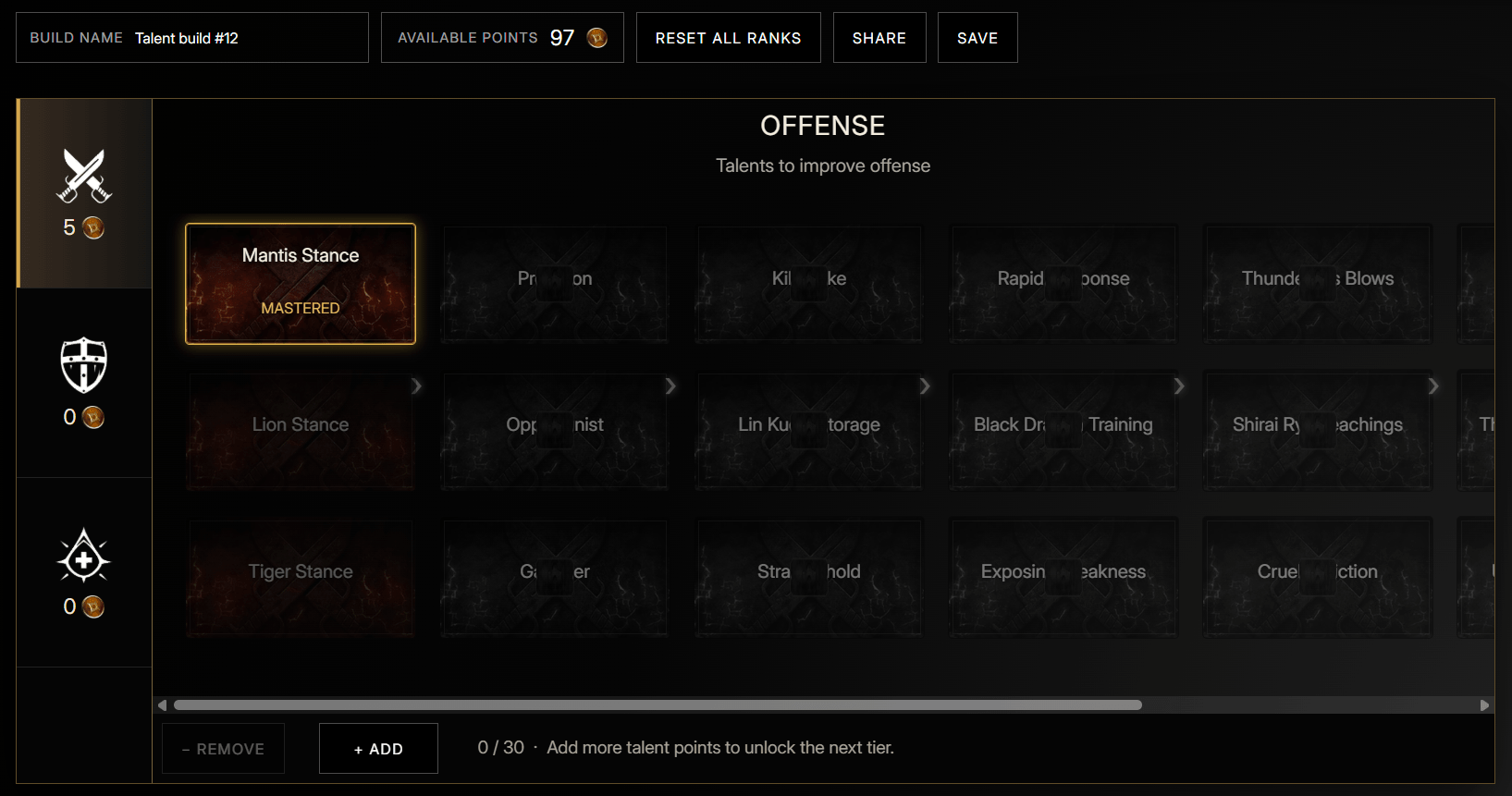
You can also build your own setup in the MK Mobile Talent Builder, spend up to 102 points, save the build and share it with other players.
This guide is written for the current MK Mobile 7.4 environment. For related team planning, compare the Best Teams, Squad Guides, Tower database and Krypt Guide.
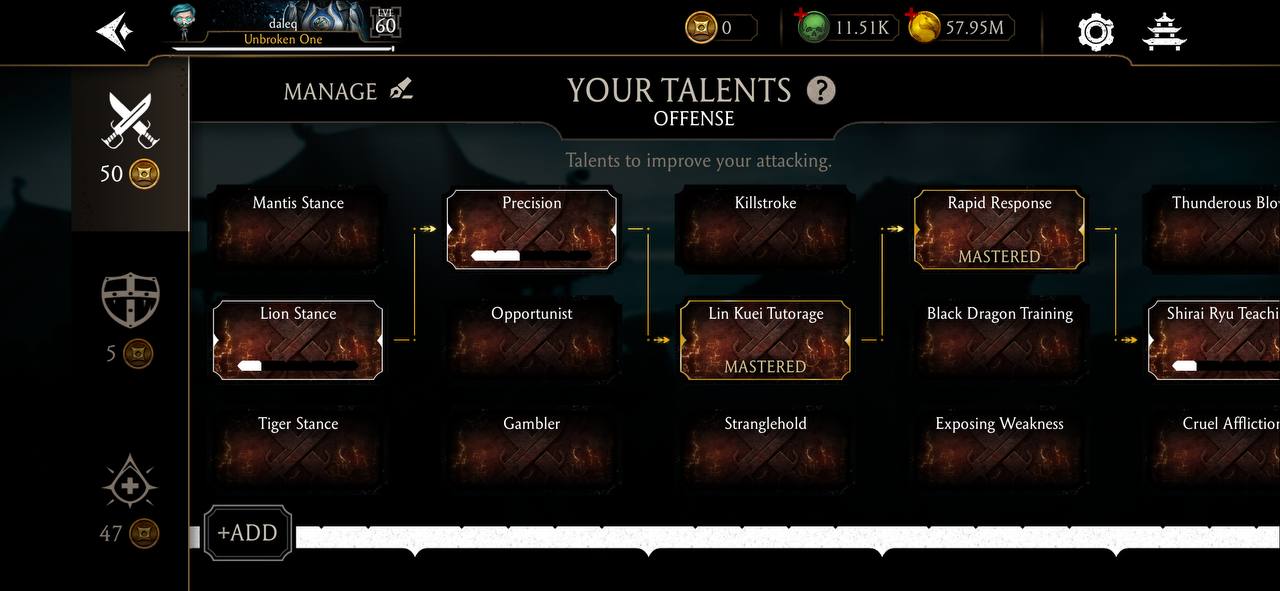
How the MK Mobile Talent Tree works
The normal Talent Tree contains three branches:
- Offense
- Defense
- Support
Each branch contains several tiers. To reach deeper talents, you must spend enough points along that branch to unlock the next tier.
This means a final-tier talent does not cost only the points shown on that talent itself. You also need to invest in the route leading to it.
A complete current setup uses up to 102 Talent Points.
That point limit matters when planning a build. You usually cannot maximize every strong talent from all three branches, so the real question is not:
“Which talents are good?”
It is:
"Which talents are worth giving up other talents for?"
The Talent Builder lets you test that distribution before changing anything in game.
Where do Talent Points come from?
Talent progression is connected to Shao Kahn's Tower.
Talent Points earned there are used to develop the normal account-wide Talent Tree. Talent Points are limited by the account progression system; reaching the cap does not create an unlimited source of additional points.
This is different from Event Towers such as Fatal or Normal Towers.
It is also important not to confuse the regular Talent Tree with Tower Talents in Realm Klash. Klash defensive Towers have their own separate Talent system. Changing those defensive Tower Talents does not require rebuilding your normal account Talent Tree.
Do not spread points randomly
A common early mistake is putting a few points into every talent that looks useful.
That creates a tree with many small bonuses but no clear strategy.
A stronger setup usually has one or two main goals:
- apply Death Mark;
- create Snare through Power Drain;
- survive lethal damage;
- protect against debuffs;
- strengthen DOT;
- improve Critical damage;
- reduce Special Attack 1 or Special Attack 2 Power cost;
- support a finishing setup;
- deal with enemy Kameos.
Choose the job first, then build the route around it.
A strong general Talent Tree foundation
For a general progression setup, several talents repeatedly provide useful value:
Precision
Useful for builds that rely heavily on Combo Enders. More reliable Combo Enders create more opportunities for effects such as Death Mark Technique and character or Equipment triggers.
Death Mark Technique
One of the most useful general offensive final talents. Combo Enders have a chance to apply Death Mark for 20 seconds. It disables resurrection and increases further damage taken by 10%, stacking up to three times.
Weak Point Attacks
Especially strong when your team applies Power Drain consistently. Power Drain can create Snare, helping you keep an important target active.
Hawk Stance
A strong general defensive option because it provides broad resistance against debuffs rather than countering only one specific effect.
This combination gives you offense, resurrection control, tag control and protection against debuffs without committing the entire tree to one specialized mechanic.
You can open the ready-made General, Death Mark and Tower Bosses builds in Talent Builds & Presets to compare how the points are distributed.
Death Mark Technique — why it is so useful
Death Mark Technique remains one of the most flexible final Offense talents.
Its main advantage is that it does not require one specific character.
If your fighters consistently perform Combo Enders, they can gain access to Death Mark through the Talent Tree.
Death Mark is useful because it:
- prevents resurrection;
- increases damage taken by the affected enemy;
- works naturally with Combo Ender-heavy attackers.
This can matter against ordinary enemies, Tower battles and opponents whose main defense is resurrection.
The important limitation is the trigger.
A character that rarely completes Combo Enders cannot use Death Mark Technique as efficiently as a fighter with a fast and reliable basic-attack chain.
That is why Precision is often paired with Death Mark-focused builds.
Death Mark Technique or Special Ending?
These talents serve different purposes.
Death Mark Technique
Choose it when you want a broadly useful anti-resurrection tool that works with Combo Enders.
It does not require a particular Brutality or Friendship Equipment set.
Special Ending
Choose it when your team is specifically built around eligible finishing Equipment and you want access to mid-fight finishing mechanics.
Special Ending does not give a fighter a Brutality or Friendship by itself.
The character still needs the appropriate Equipment and all required conditions.
For most general-purpose accounts, Death Mark Technique is easier to justify.
Special Ending becomes much more valuable when you deliberately create a separate finisher preset for the characters and Equipment that can actually use it.
Do not spend a deep Offense route on Special Ending if your current team cannot trigger its main benefit.
Weak Point Attacks " excellent, but only with Power Drain
Weak Point Attacks is one of the best examples of a talent that can be amazing or almost useless depending on the team.
Its value comes from combining Power Drain with Snare.
If your main fighter repeatedly drains Power, Weak Point Attacks can help keep the opponent on the field.
This is particularly useful when you want to:
- isolate one dangerous opponent;
- prevent a weakened target from escaping;
- maintain pressure on the enemy you are already controlling;
- keep a target active while applying your main damage rotation.
But Weak Point Attacks does not create Power Drain by itself.
If your team has no reliable source of Power Drain, spending heavily to reach this talent makes much less sense.
Always check the trigger before copying a popular Talent Tree.
Hawk Stance " strong general resistance
Hawk Stance is valuable because difficult MK Mobile battles frequently rely on debuffs.
A team can lose control of the fight because of Power Drain, Cripple, Snare, Frostbite, DOT or another negative effect.
Hawk Stance provides broad resistance rather than forcing you to predict only one debuff.
That makes it a practical low-investment defensive talent in many general builds.
It is not mandatory when your characters already have strong immunity or resistance through passives and Equipment, but for a mixed account it remains one of the easiest defensive talents to justify.
Best defensive Talents for Krypt and Survivor
Krypt and Survivor reward survival differently from an ordinary single fight.
Losing a character can affect the rest of the run, so defensive talents become more valuable.
Two of the most important deep Defense options are:
Revenant
On a player death, it has a chance to reduce the fighter to 1 Health and grant 5 seconds of invulnerability.
Shinnok's Teachings
After the opponent performs a Special Attack, it has a chance to apply Bone Shield for 5 seconds; while active, incoming hit damage is ignored.
These effects are chance-based.
They should be treated as emergency protection rather than a strategy that is guaranteed to activate every time.
A defensive build can combine Revenant and Shinnok's Teachings with resistance and Support talents to create a much safer setup for long runs.
You can compare the ready-made Krypt and Survivor setups in Talent Builds & Presets.
Offense or Defense " which is better?
Neither branch is universally stronger.
For fast ordinary battles, additional offense may save more time than defensive protection.
For a difficult Krypt run, saving one character with Revenant may be worth more than another small damage bonus.
For Tower bosses, the answer depends on the team. If you already survive comfortably but run out of time, more offense is usually the priority. If the boss kills the main attacker before your damage rotation begins, survivability has more value.
Talent Trees should solve the reason you are losing.
Do not copy a defensive setup when the real problem is insufficient damage, and do not copy a glass-cannon setup when your carry dies before using its important Special Attack.
Best Talent Tree for DOT teams
DOT teams should not simply copy a normal Critical build.
If your strategy revolves around Fire, Poison or Bleed, several Offense talents become much more interesting.
Stranglehold
Improves basic-attack pressure against enemies already affected by DOT.
Exposing Weakness
Improves Special Attack damage against opponents affected by Fire, Poison or Bleed.
Cruel Affliction
Directly strengthens Fire, Poison and Bleed DOT damage.
This creates an actual DOT route rather than simply adding generic Attack bonuses.
The current Talent Builds & Presets section includes a dedicated DOT preset designed around this style.
Remember that a DOT Talent Tree is only valuable when the enemy can actually be affected by your DOT effects.
Against immunity or modifiers that neutralize your main damage source, switch presets rather than forcing the same build.
Critical builds
Critical-focused teams want different offensive bonuses from DOT teams.
Talents such as Black Dragon Training and other Critical-focused nodes can improve a fighter whose damage already depends heavily on Critical Hits.
The key is to make sure the team's real damage source can benefit.
A Critical preset is less attractive when:
- the opponent strongly reduces Critical Hit chance;
- your important damage source cannot Crit;
- your team gets more value from DOT or Special Attack pressure;
- survival is currently the main problem.
MK Mobile Base has a ready-made Critical setup in Talent Builds & Presets.
Use it as a starting point, then change the route if your main attacker has different needs.
Special Attack 1 builds " use talents that support repeated first Specials
Some characters win fights by repeatedly using Special Attack 1.
For those teams, Meditation is one of the most obvious Support talents because it reduces Special Attack 1 Power cost.
This works especially well when Special Attack 1 already provides an important mechanic such as:
- Power Drain;
- Snare;
- DOT;
- another important debuff;
- efficient direct damage.
Reducing the cost of an attack you already plan to spam is usually more valuable than improving a Special Attack you almost never use.
Open the First Special preset in Talent Builds & Presets to see a full Special Attack 1-oriented route.
Special Attack 2 builds " do not copy Special Attack 1 priorities
A fighter built around Special Attack 2 should not automatically use the same Support route.
Conditioning is the more natural talent for reducing Special Attack 2 Power cost.
This can be especially valuable for characters whose Special Attack 2 provides:
- their main burst damage;
- healing;
- an important buff;
- control;
- a powerful character-specific passive trigger.
MK Mobile Base includes a separate Second Special preset in Talent Builds & Presets.
Keeping Special Attack 1 and Special Attack 2 builds separate is useful because specializing usually gives better value than spending points on both just because both talents exist.
Horse Stance in Update 7.4
Horse Stance deserves a special note because its behavior was clarified in Update 7.4.
The current Power Generation bonus applies only to the player's team, so current in-game behavior is more reliable than older descriptions.
That makes current live behavior more important than old Talent Tree screenshots or videos.
Always check current talent descriptions when using an older guide, especially when a talent has been changed or fixed in recent patches.
Talents for Kameo battles
Kameos introduced another reason to maintain specialized Talent presets.
Binding Blow is a deep Support talent designed for battles where the opponent's defensive Kameo repeatedly interrupts your pressure.
It depends on Combo Enders and is useful primarily when an enemy Kameo is actually part of the battle.
This makes Binding Blow a specialist talent.
Do not build an entire deep Support route around it for content where the opponent does not have a Kameo or where defensive Kameo attacks are not causing problems.
The same principle applies throughout the Talent Tree:
a powerful effect with no valid trigger is still a wasted investment.
Build around your team's actual triggers
Before spending Talent Points, look at what your three characters really do.
Ask:
- Do they land Combo Enders consistently?
- Do they apply Power Drain?
- Is the team built around Special Attack 1 or Special Attack 2?
- Does it rely on Fire, Poison or Bleed?
- Does resurrection regularly stop your progress?
- Are debuffs killing your rotation?
- Do you need survival or more damage?
- Is an enemy Kameo actually causing the problem?
Then choose talents.
This is much more reliable than copying a screenshot from a completely different team.
Use presets instead of rebuilding one tree constantly
MK Mobile Base currently provides ready-made presets for:
- Tower Bosses;
- Krypt;
- Survivor;
- General;
- DOT;
- Critical;
- Death Mark;
- Second Special;
- First Special.
You can browse them in MK Mobile Talent Builds & Presets.
A practical approach is to keep several clear purposes in mind.
General
A flexible tree for everyday difficult battles.
Tower Bosses
Focus on damage, resurrection control and mechanics that support long boss attempts.
Krypt
Prioritize survival and consistency.
Survivor
Protect the roster and reduce the chance that one mistake ends the run.
DOT
Strengthen Fire, Poison and Bleed strategies.
Critical
Increase value from Critical-focused attackers.
Death Mark
Commit more heavily to Combo Enders and resurrection control.
First Special
Support repeated Special Attack 1 rotations.
Second Special
Support fighters whose main strategy depends on Special Attack 2.
There is no reason to force one build to perform every job.
Create your own Talent Tree
Ready-made presets are useful, but the strongest setup for your account may still be different.
Use the MK Mobile Talent Builder to build your own route before changing it in game.
The builder allows you to:
- switch between Offense, Defense and Support;
- spend up to 102 points;
- see how many points remain;
- plan the route through each tier;
- reset the build;
- name the setup;
- save it to your account;
- share the finished Talent Tree with another player.
This is especially useful when comparing two different builds.
Instead of repeatedly resetting your in-game tree, create both versions in the builder and compare exactly what you gain and lose.
A simple way to create a custom build
Start with one question:
What is this Talent Tree supposed to fix?
If the answer is resurrection, build toward Death Mark.
If the answer is a Power Drain team that needs target control, include Weak Point Attacks.
If the team dies too easily in long runs, consider Revenant and Shinnok's Teachings.
If the strategy revolves around Fire, Poison and Bleed, use the DOT route.
If the main attacker repeatedly uses Special Attack 1, invest in Special Attack 1 support.
If Special Attack 2 is the real engine, build around Special Attack 2 instead.
After selecting the core talent, spend the remaining points on effects that activate consistently.
A smaller reliable bonus is often better than a stronger talent your team rarely triggers.
Common Talent Tree mistakes
- Searching for one universal “best Talent Tree.”
- Spreading points across all three branches without a clear goal.
- Using Weak Point Attacks without reliable Power Drain.
- Using Death Mark Technique with characters that rarely complete Combo Enders.
- Choosing Special Ending without the required finisher Equipment.
- Investing deeply into DOT talents against enemies that resist or ignore DOT.
- Building full Defense when the actual problem is the battle timer.
- Building full Offense when the main attacker dies immediately.
- Using Special Attack 1 cost reduction on an Special Attack 2-focused team.
- Copying an old Talent Tree without checking recent patches.
- Using Binding Blow when there is no enemy Kameo worth suppressing.
- Ignoring the 102-point limit when planning deep talents in multiple branches.
- Keeping the same setup after completely changing the main team.
Which Talent Tree should you use?
If you are unsure where to start, use a balanced general setup built around:
Precision + Death Mark Technique + Weak Point Attacks + Hawk Stance
This provides a strong foundation for many Tower and progression teams, especially when your characters already use Combo Enders and Power Drain.
For Krypt and Survivor, consider shifting more points into Defense and reaching Revenant + Shinnok's Teachings.
For DOT teams, replace generic offensive priorities with talents such as Stranglehold, Exposing Weakness and Cruel Affliction.
For finishing setups, compare Special Ending with Death Mark Technique instead of assuming both solve the same problem.
Most importantly, do not treat a Talent Tree as permanent.
Your best build changes when your team, Equipment, mode or opponent changes.
Browse the current ready-made setups in MK Mobile Talent Builds & Presets, then use the MK Mobile Talent Builder to create and share a version built around your own account.
Thank you for reading, and good luck with your MK Mobile account progression!